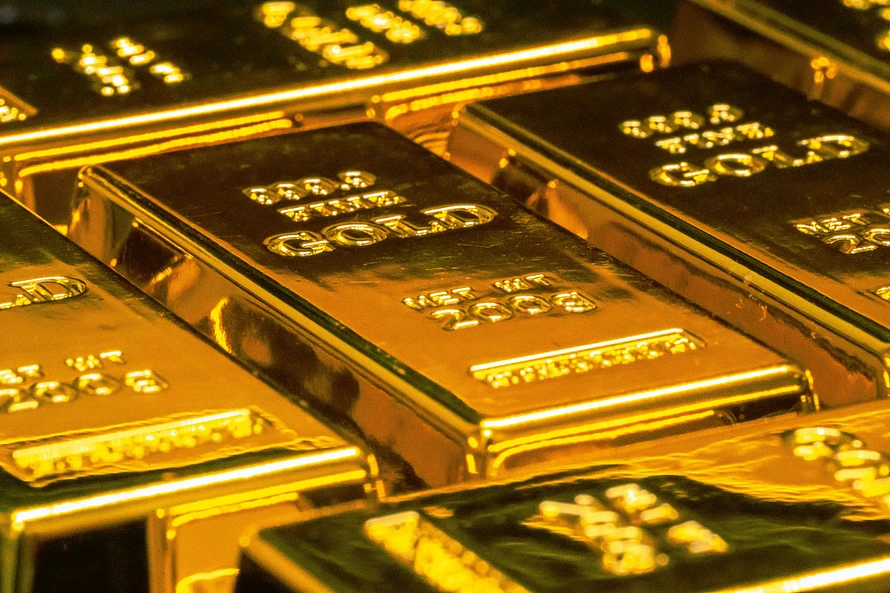
If you are asking, “What is the current price of gold?”, the honest answer is this: the live spot price of gold is around $4,656 to $4,672 per ounce as of April 7, 2026, depending on the exact time and pricing source you check. That is the global reference price for raw gold in the market, not necessarily the final price you would pay for a physical coin or bar.
For a physical buyer, that distinction matters.
When you buy an American Gold Eagle, a Maple Leaf, or a small gold bar, you are not buying at bare spot. You are buying at spot plus a premium. That premium covers minting, fabrication, dealer costs, distribution, and the added value of recognizability and resale convenience. So the better question is not only “What is gold today?” but also “What does today’s gold price mean for someone trying to protect savings with physical metal?”
Why This Question Matters in 2026
This is not a routine year for gold buyers.
Gold rose strongly earlier in 2026, then suffered a sharp March decline. Reuters reported spot gold at about $4,655.89 on April 7, while MoneyWeek noted gold closed March around $4,672 after an unusually steep monthly drop. Reuters also reported that China’s central bank increased its gold holdings again in March, marking a 17th straight month of purchases, which suggests official demand is still helping support the market.
That leaves prudent buyers in a familiar position. They are not trying to day-trade headlines. They are trying to decide whether today’s price is reasonable for long-term wealth protection.
That is exactly why the current gold price matters. Not because you need to predict every move, but because you want to avoid confusing a live market quote with a sound physical buying decision.
What You Should Weigh Before Buying at Today’s Gold Price
1. Spot price versus real purchase price
Spot is the benchmark. Your actual cost is higher. A one-ounce sovereign coin will usually carry a larger premium than a larger bar, but that higher premium can buy you better recognizability and easier resale.
2. Coin or bar format
If your priority is broad recognizability and straightforward liquidity, government-minted bullion coins often make sense. If your priority is keeping the premium lower, common bars may offer better value per ounce.
3. Position size
Gold is dense value. That is one of its strengths. A modest dollar amount can buy a meaningful amount of wealth storage in a very compact form. That makes gold appealing for buyers concerned about discreet storage, portability, and estate transfer.
4. Liquidity later
The gold you buy today should still be easy to sell later. Widely recognized products tend to be easier to move than obscure pieces, especially if you need to sell only part of your holdings.
5. Your reason for buying
If your goal is long-term purchasing power protection, then today’s quote is important, but not everything. The more important question is whether the purchase fits your broader savings plan, cash reserves, and time horizon.
A Simple Decision Framework for a Cautious Buyer
Here is a practical way to think about it.
If you want the lowest friction purchase, start by comparing common one-ounce bars and the most recognizable bullion coins. Look at the premium in dollar terms, not just percentage terms.
If you want maximum resale confidence, lean toward widely traded sovereign bullion coins. Paying a bit more up front can be reasonable if it buys you easier verification and broad buyer recognition later.
If you are worried about buying at the wrong moment, avoid the all-or-nothing mindset. Instead of trying to call the exact bottom, consider buying in stages. That reduces the emotional pressure that comes with a single large purchase.
If your main concern is storage, gold has a clear advantage over silver. It stores a large amount of value in a small space, which can simplify secure home storage or professional vaulting arrangements.
Common Concerns, Answered Plainly
“What if the price drops right after I buy?”
That can happen. Gold does not move in a straight line. In fact, March showed exactly how quickly it can correct. But for a long-term physical holder, a short-term dip is not the same thing as a failed decision. If your purpose is wealth preservation, the right benchmark is not next week. It is whether the metal still serves as a durable store of value over years, not days.
“What if premiums are too high?”
That is a legitimate concern. Sometimes a cheaper product per ounce is the smarter buy, especially if you are focused on accumulation. But low premium is not the only goal. A very liquid, highly recognized coin may justify a somewhat higher premium if it better fits your future exit options.
“Should I wait for a better price?”
Maybe, but nobody knows in advance where the next better price will be. Reuters reported analysts remain divided, with UBS recently revising its June-end gold forecast to $5,200, while other market forecasts for year-end 2026 run even higher. Forecasts can be useful background, but they are not guarantees.
For most prudent buyers, the better approach is not prediction. It is discipline.
The Bigger Question Behind Today’s Gold Price
The current gold price gives you a snapshot. It does not tell you, by itself, whether gold is more attractive than silver, whether one metal has run too far relative to the other, or whether a blended approach makes more sense for your household.
That is where the broader relationship between gold and silver becomes useful.
A buyer who understands how the two metals move together, and when they do not, is in a better position to judge allocation, timing, and value. Today’s gold quote is the starting point. It is not the full picture.
The main takeaway is simple: the current gold price matters, but the right physical buying decision depends on premium, product choice, liquidity, storage, and your long-term purpose. A careful, research-driven approach is exactly the right one for someone trying to protect wealth rather than chase excitement.